
Keely
"All vibrations that are negative in their character as toward destroying the harmonic relations that exist between the magnetic current and its coincident polar, to carry out the simile, close up the aperture whereby illumination (or transfer) is continuously conducted.
The thirds, on the subdivision of the one hundred and twenty-eight thousand four hundred vibrations, represent the negative antagonism, whereby this peculiar condition is brought about, viz., forty-two thousand eight hundred on the positive; the same on the negative and on the neutral, as associated with the sympathetic negative transmitter.
The keeper is first placed on the magnet, which has an attachment whereby a transmitter can be centrally associated with it; the other terminal having three connections that can be attached to this medium. The impulse is given simultaneously to the three leads after setting the instrument to represent forty-two thousand eight hundred vibrations on the harmonic, the same on the enharmonic and on the diatonic.
If this impulse is given properly, the neutralization will take place within fifteen seconds." [The Operation of the Vibratory Circuit]
Russell
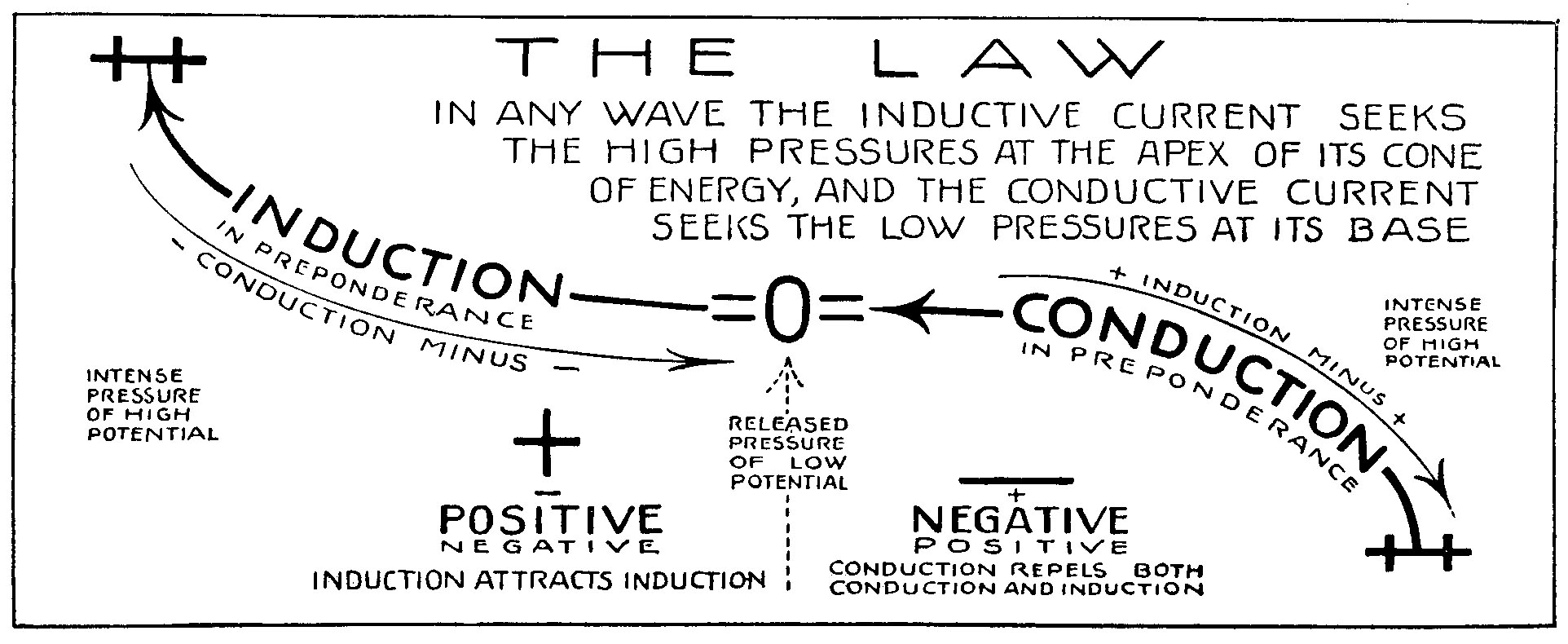
"In any wave the inductive current seeks the high pressures at the apex of its cone of energy, and the conductive current seeks the low pressures at its base.
"Conduction repels both Conduction and Induction.
"Induction attracts Induction." Russell, The Universal One
"At the intersection of two temperature gradients atomic energy is released. Whether it is a formative or destructive energy is determined in each case by the type of movement and the composition of the alloys used to build the motion-producing machine." [Viktor Schauberger, Implosion Magazine, No. 71, p. 12.] [The Energy Evolution - Harnessing Free Energy from Nature, THE NATURE OF WATER - ITS CONDUCTION AND USE FOR TRANSPORT]
The open secret of water consists in the fact that processes of organic synthesis take place in the naturalesque conduction of water, whereas processes of organic analysis occur when it is conducted unnaturally. In the former case, the growth of water and an increase in latent energy occurs, hence a qualitative improvement. In the latter case, it results in the disappearance of water, to losses in latent energy and logically to a decline in quality. [The Energy Evolution - Harnessing Free Energy from Nature, The Transport of Ore in Double-Spiral-Flow Pipes]
Nikola Tesla
“In the summer of 1897 Lord Kelvin happened to pass through New York and honored me by a visit to my laboratory where I entertained him with demonstrations in support of my wireless theory. He was fairly carried away with what he saw but, nevertheless, condemned my project in emphatic terms, qualifying it as something impossible, “an illusion and a snare.” I had expected his approval and was pained and surprised. But the next day he returned and gave me a better opportunity for explanation of the advances I had made and of the true principles underlying the system I had evolved. Suddenly he remarked with evident astonishment: “Then you are not making use of Hertz waves?” “Certainly not,” I replied, “these are radiations. No energy could be economically transmitted to a distance by any such agency. In my system the process is one of true conduction which, theoretically, can be effected at the greatest distance without appreciable loss.” I can never forget the magic change that came over the illustrious philosopher the moment he freed himself from that erroneous impression. The skeptic who would not believe was suddenly transformed into the warmest of supporters. He parted from me not only thoroughly convinced of the scientific soundness of the idea but strongly exprest his confidence in its success…” [Nikola Tesla, “Famous Scientific Illusions.” Electrical Experimenter, February, 1919]
DP: I had a thought that the sympathetic streams are the functional dynamic of conduction. Not sure of course. Check out conduction and see what you think. https://svpwiki.com/Conduction
ChatGPT: I think you may have found a useful connection. On the Conduction page, Keely describes a transfer that is continuously conducted while a particular harmonic relation remains intact. He then describes an antagonistic vibratory condition that closes the “aperture” for that transfer. In the full account of the vibratory circuit, sympathetic currents pass through a resonating intensifier, while the transmitter and its introductory impulse bring previously latent conditions into action.
That makes your thought plausible within Keely’s framework: sympathetic streams may be what participates in the transfer, while conduction names the established passage or process by which that transfer occurs. The harmonic relation appears to govern whether the passage remains open; an antagonistic relation can interrupt it. I would keep “functional dynamic of conduction” as a working interpretation, since the passage does not explicitly define sympathetic streams as conduction itself.
A compact formulation for our Volume 78 notes might be:
Conduction is sympathetic transfer through an established relation. Sympathetic streams supply the active flows; concordance permits their passage, while antagonism can restrict or close it.
This also gives us a concrete question for the chart study: What establishes the conducting relation, and what changes it from open to closed? Keely’s description of the three leads and harmonic, enharmonic, and diatonic settings may help us answer that without assuming ordinary electrical conduction is the whole of what he means. [9-24-26]
See Also
conduct
Conductivity
Conductor
Entropy
Magnetic Lines of Force developed from Induction of Current Flow
Law of Electric Conductivity
Magnetism
Resistance
Sympathetic Induction
Syntropy
Theory of the Induction of Sympathetic Chords to Excite Rotation
Vacuum from Vibratory Induction