
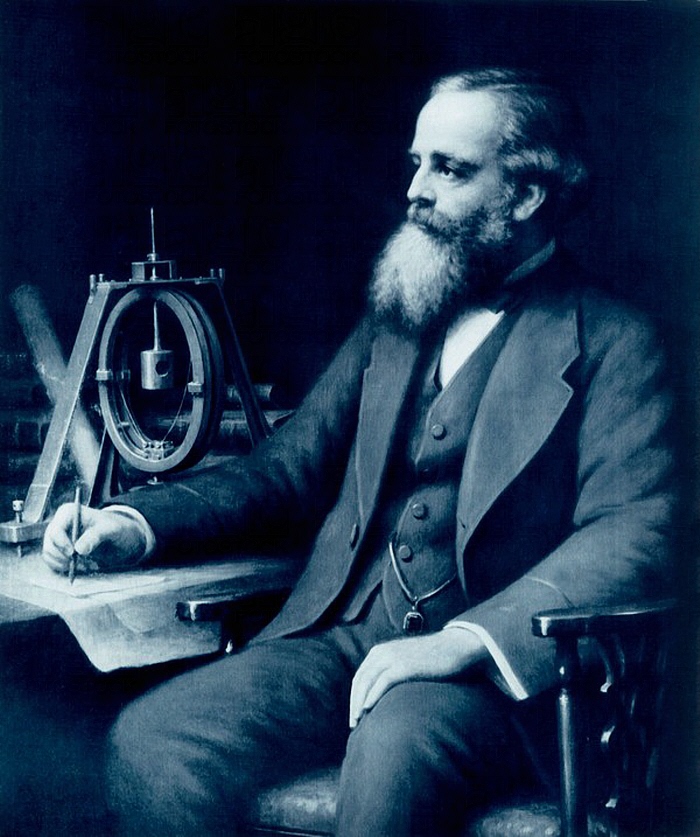
James Clerk Maxwell (13 June 1831 - 5 November 1879) was a Scottish theoretical physicist and mathematician. His most important achievement was classical electromagnetic theory, synthesizing all previously unrelated observations, experiments and equations of electricity, magnetism and even optics into a consistent theory. His set of equations - Maxwell's equations - demonstrated that electricity, magnetism and even light are all manifestations of the same phenomenon: the electromagnetic field. From that moment on, all other classic laws or equations of these disciplines became simplified cases of Maxwell's equations. Maxwell's work in electromagnetism has been called the "second great unification in physics", after the first one carried out by Isaac Newton. (WikiPedia)
James Clerk Maxwell
"The experimental investigation by which Ampere established the law of the mechanical action between electric currents is one of the most brilliant achievements in science. The whole, theory and experiment, seems as if it had leaped, full grown and full armed, from the brain of the 'Newton of Electricity.' It is perfect in form, and unassailable in accuracy, and it is summed up in a formula from which all the phenomena may be deduced, and which must always remain the cardinal formula of electro-dynamics." [James Clerk Maxwell]
Keely
"Clerk Maxwell seems, when theorizing on sound transmission by an atmospheric medium, not to have taken into consideration the philosophy attending the phenomena of the origination of electric streams in celestial space. Light is one of the prominent evolved mediums in electric action, and is evolved by corpuscular bombardment induced by sympathetic streams acting between the neutral centres of planetary masses, all of which are under a condition of unstable equilibrium. These unstable conditions were born in them, and were thus designed by the Architect of Creation in order to perpetuate the connective link between the dispersing positive and the attractive negative. The action that induces this link I call sympathetic planetary oscillation." [Vibratory Physics - The Connecting Link between Mind and Matter]
"''Maxwell's theory is correct that the plane of polarized light is the plane of magnetic force. The sympathetic vibrations associated with polarized light constitute the pure coincident of the plane of magnetism. Therefore, they both tend to the same path, for both are interatomic, assimilating sympathetically in a given time, to continue the race together, although one precedes the other at the time of experimental evolution. The time is approaching when electromagnetic waves with an outreach of two feet will be produced, having an energy equal to that now shown up on the magnet when it is about to kiss its keeper, and showing a radiating force too stupendous for actual measurement.’' [ELECTROMAGNETIC RADIATION - Snell]
Hughes
The tones between the seven white notes of keyed instruments, and the tints and shades between the seven colours, cause the multequivalency of colours and of tones; consequently every colour, as every musical harmony, has the capability of ascending or descending, to and fro in circles, or advancing and retiring in musical clef. It is a curious coincidence that Wünsch, nearly one hundred years ago, believed in his discovery of the primary colours to be red, green, and violet; and in this scheme, red, answering to the note C, must necessarily be the first visible colour, followed by green and violet, but these not as primary colours, all colours in turn becoming primaries and secondaries in the development of the various harmonies. To gain facts by experiment, the colours must be exactly combined according to natural proportions—certain proportions producing white, and others black. In this scheme, green and red are shown to be a complementary pair, and therefore (as Clerk Maxwell has proved) red and green in right proportions would produce yellow. The same fact has been proved in Lord Rayleigh's experiments with the spectroscope. Yellow and ultra-violet, [Harmonies of Tones and Colours, On Colours as Developed by the same Laws as Musical Harmonies3, page 20]
James Clerk Maxwell (1831 - 1879)
"The numbers may be said to rule the whole world of quantity, and the four rules of arithmetic may be regarded as the complete equipment of the mathematician."
Everyone's a fan of Albert Einstein, and for good reason: He invented at least four new fields of physics, spun a brand-new theory of gravity out of the fabric of his own imagination, and taught us the true nature of time and space. But who was Einstein a fan of?
James Clerk Maxwell. Who? Oh, he's only the scientist responsible for explaining the forces behind the radio in your car, the magnets on your fridge, the heat of a warm summer day and the charge on a battery.
Most people aren't familiar with Maxwell, a 19th-century Scottish scientist and polymath. Yet he was perhaps the single greatest scientist of his generation and revolutionized physics in a way nobody was expecting. In fact, it took years for Maxwell's peers to realize just how awesome — and right — he was.
At the time, one of the great focuses of scientific interest was the strange and perplexing properties of electricity and magnetism. While the two forces had been known to humanity for millennia, the more scientists studied these forces, the weirder they seemed.
Ancient people knew that certain animals, like electric eels, could shock you if you touched them and that certain substances, like amber, could attract things if you rubbed them. They knew that lightning could start fires. They had found seemingly magical rocks, called lodestones, that could attract bits of metal. And they had mastered the use of the compass, albeit without understanding how it worked.
By the time Maxwell stepped in, a wide variety of experiments had expanded on the weirdness of these forces. Scientists like Benjamin Franklin had discovered that the electricity from lightning could be stored. Luigi Galvani found that zapping living organisms with electricity caused them to move.
M
eanwhile, French scientists found that electricity moving down a wire could attract — or repel, depending on the direction of the flow — another wire and that electrified spheres could attract or repel with a strength proportional to the square of their separation.
Most bewilderingly, there seemed to be a strange link between electricity and magnetism. Electrified wires could deflect the motion of a compass. Starting the flow of electricity in one wire could spur the flow of electricity in another, even if the wires weren't connected. Waving a magnet around could generate electricity.
All of this was absolutely fascinating, but nobody had any idea what was going on.
Then Maxwell came along. He had heard about all this electricity and magnetism confusion while he was working on another problem: how color vision works. (Indeed, he invented the color photograph.)
In just a few years, Maxwell envisioned the physics and mathematics needed to explain all of the experiments relating to electricity and magnetism.
To do it, he just had to think like a future scientist.
Today, modern physics is based on the concept of the field, an entity that spans all of space and time and tells other objects how to move. While Maxwell wasn't the first to envision such a field, he was the first to put it to work and turn it from a convenient mathematical trick into a real physical entity.
For example, Maxwell envisioned the forces of electricity and magnetism to be carried and communicated by electric and magnetic fields. Maxwell said an electric charge would produce an electric field that surrounded it. Any other charges could sense this field, and based on the strength and direction of the field, it would know how to respond to the force of the original charge.
The same went for the magnetic field, and Maxwell took it one step further. He realized that electric and magnetic fields are two sides of the same coin: Electricity and magnetism weren't two separate, distinct forces, but merely two expressions of the same, unified electromagnetic force. You can't think about electricity without also thinking about magnetism, and vice versa.
Let there be light
Maxwell's insights took the form of 20 interconnected equations, which, a few years later, were reduced to four equations of electromagnetism that are still taught to scientists and engineers today. His revolution followed Isaac Newton's first unification of physics, in which Earth's gravity was joined with the gravity of the heavens under a single law, and Maxwell's equations became known as the second great unification in physics.
Maxwell's insight was huge — who would have guessed that electricity and magnetism weren't just related, but the same? Modern physics is all about finding single unifying principles to describe vast areas of natural phenomena, and Maxwell took the unification party to the next level.
But Maxwell didn't stop there. He realized that changing electric fields could induce magnetic fields, and vice versa. So he immediately began to wonder if such a setup could be self-reinforcing, wherein a changing electric field would create a changing magnetic field, which could then create a changing electric field and so on.
Maxwell realized that this would be a wave — a wave of electromagnetism. He set about calculating the speed of these electromagnetic waves, using the strengths of the forces of electricity and magnetism, and out popped … the speed of light.
By introducing the concept of the field to the analysis of electricity and magnetism, Maxwell discovered that light — in all its forms, from the infrared, to radio waves, to the colors of the rainbow — was really waves of electromagnetic radiation.
With one set of equations, one brilliant leap of intuition and insight, Maxwell united three great realms of physics: electricity, magnetism and optics. No wonder Einstein admired him.
Note: Electromagnetism
His paper On Physical Lines of Force—written over the course of two years (1861-1862) and ultimately published in several parts—introduced his pivotal theory of electromagnetism. Among the tenets of his theory were (1) that electromagnetic waves travel at the speed of light, and (2) that light exists in the same medium as electric and magnetic phenomena.
In 1865, Maxwell resigned from King’s College and proceeded to continue writing: A Dynamical Theory of the Electromagnetic Field during the year of his resignation; On reciprocal figures, frames and diagrams of forces in 1870; Theory of Heat in 1871; and Matter and Motion in 1876. In 1871, Maxwell became the Cavendish Professor of Physics at Cambridge, a position that put him in charge of the work conducted in the Cavendish Laboratory. The 1873 publication of A Treatise on Electricity and Magnetism, meanwhile, produced the fullest explanation yet of Maxwell’s four partial different equations, which would go on to be a major influence on Albert Einstein’s theory of relativity. On November 5, 1879, after a period of sustained illness, Maxwell died—at the age of 48—from abdominal cancer.
Considered one of the greatest scientific minds the world has ever seen—on the order of Einstein and Isaac Newton—Maxwell and his contributions extend beyond the realm of electromagnetic theory to include: an acclaimed study of the dynamics of Saturn’s rings; the somewhat accidental, although still important, capturing of the first color photograph; and his kinetic theory of gases, which led to a law relating to the distribution of molecular velocities. Still, the most crucial findings of his electromagnetic theory—that light is an electromagnetic wave, that electric and magnetic fields travel in the form of waves at the speed of light, that radio waves can travel through space—constitute his most important legacy. Nothing sums up the monumental achievement of Maxwell’s life work as well as these words from Einstein himself: “This change in the conception of reality is the most profound and the most fruitful that physics has experienced since the time of Newton.”
Image credit: Stefano Bianchetti/Corbis via Getty Images
https://www.britannica.com/biography/James-Clerk-Maxwell
James Clerk Maxwell changed science by bringing electricity and magnetism together. Before his work they were seen as separate subjects. Maxwell showed that both were connected through simple rules. These rules became a single framework that explained how electric and magnetic fields behave.
He took earlier ideas from many scientists and combined them with new insights. By unifying these laws he created four equations that described every known behavior of electric and magnetic fields. These equations became the base of classical electromagnetism. They remain essential in physics today.
One of his greatest discoveries was that these fields can move through space as waves. When an electric field changes it creates a magnetic field. When the magnetic field changes it creates an electric field. This cycle moves forward like a ripple and forms an electromagnetic wave.
Maxwell calculated the speed of these waves and found that the value matched the speed of light. This result showed something remarkable. Light is not separate from electricity and magnetism. Light is an electromagnetic wave. This idea transformed our understanding of nature.
His work opened the path to radio waves microwaves and many technologies that shape daily life. It also inspired the development of modern physics. Maxwells equations remain a landmark achievement. They show how simple laws can connect different parts of the natural world into one clear picture.
14 equations - https://svpwiki.com/pdffiles/Orig_maxwell_equations.pdf
In 1865, a man sat at a desk in the Scottish countryside and wrote down a set of numbers that would change your life forever. Most people have never heard his name, but without him, you wouldn't be reading this on a digital screen right now.
His neighbors saw a quiet, humble man who served as an elder in his local church. But inside his mind, he was seeing the invisible architecture of the universe.
James Clerk Maxwell was a man of deep faith who believed that because God created the world, it must operate with perfect order. He set out to find the mathematical language for that order.
He eventually derived four equations that unified electricity, magnetism, and light. He proved that they were all part of the same thing: electromagnetic waves.
At the time, many of his peers dismissed his work as abstract math with no real-world use. They didn't understand what he was seeing.
But the numbers didn't lie. He predicted that these invisible waves could travel through the air at the speed of light.
He saw the order. He saw the logic. He saw the potential.
Maxwell died in 1879, long before the first radio was ever built or the first lightbulb became common. He never got to see a wireless transmission or a mobile phone.
Yet, every time you connect to a WiFi signal or send a text, you are using the exact physics he discovered over 150 years ago. Even Albert Einstein kept a photo of him on his wall, calling his work the most profound since Newton.
Today, we live in a wireless world built on his foundation. He found the invisible threads that hold our modern technology together.
His legacy proves that the greatest discoveries often come from those who look for the hidden patterns in creation.
Modern technology owes its existence to a Victorian physicist who followed the math where others refused to go.
Sources: National Library of Scotland / Cambridge University Physics Archive
The Gentleman Physicist: Why James Clerk Maxwell Remains Science's Model of Grace and Genius
How a 19th-century Scottish scientist showed that intellectual brilliance and moral generosity need not be mutually exclusive
In the pantheon of scientific giants, James Clerk Maxwell occupies a curious position. Ask the average person to name history's greatest physicists, and they will cite Newton or Einstein. Yet ask working physicists themselves, and Maxwell's name emerges with startling frequency. Einstein kept Maxwell's portrait on his wall. Richard Feynman called Maxwell's equations "the most significant event of the 19th century." Max Planck wrote that Maxwell's work marked "the most profound upheaval experienced by physics since Newton."
What distinguished Maxwell was not merely the depth of his genius—though that was formidable—but something rarer still: his remarkable generosity of spirit. In an era when priority disputes poisoned scientific discourse and rivals hoarded credit like misers clutching gold, Maxwell stood apart. His treatment of his predecessors, particularly Michael Faraday, offers a masterclass in how scientific achievement and intellectual humility can not only coexist but reinforce one another.
The Unlikely Partnership
The relationship between Faraday and Maxwell was, on paper, improbable. Faraday was a self-taught bookbinder's apprentice who rose to become one of Britain's greatest experimental physicists despite possessing almost no formal mathematical training. Through painstaking laboratory work, he developed revolutionary insights about electricity and magnetism, visualizing invisible "lines of force" radiating through space—a concept his mathematically trained contemporaries struggled to take seriously.
Maxwell, by contrast, was a prodigy trained in the rigorous mathematical tradition of Cambridge. Born into Scottish gentry, he possessed the analytical tools Faraday lacked. Where Faraday saw pictures and physical intuitions, Maxwell saw differential equations waiting to be written.
A lesser scientist might have viewed Faraday's work as mere preliminary sketches requiring proper mathematical refinement. Maxwell saw something else entirely: profound truth expressed in a different language.
Translation as Tribute
What Maxwell achieved between 1861 and 1865 was nothing short of astonishing. He took Faraday's experimental observations and visual intuitions about electromagnetic fields and translated them into four elegant equations—now known simply as Maxwell's equations—that unified electricity, magnetism, and light into a single theoretical framework. These equations predicted electromagnetic waves traveling at the speed of light and laid the groundwork for everything from radio to relativity.
Yet Maxwell never claimed this achievement as solely his own. In his landmark 1865 paper "A Dynamical Theory of the Electromagnetic Field," Maxwell wrote explicitly that he was building on Faraday's foundation. He described Faraday's lines of force not as useful fictions but as physical realities. In his "Treatise on Electricity and Magnetism" (1873), Maxwell devoted entire sections to explaining how his mathematical formalism emerged directly from Faraday's experimental insights.
This was not perfunctory acknowledgment buried in footnotes. Maxwell placed Faraday's contributions front and center, insisting that the older man had already glimpsed the fundamental truth and that his own role was essentially that of a translator—converting visual poetry into mathematical prose.
A Chain of Gratitude
Maxwell's generosity extended beyond Faraday. He carefully acknowledged William Thomson (Lord Kelvin), whose earlier attempts to mathematize electromagnetic theory, though incomplete, provided crucial stepping stones. Maxwell studied Thomson's work closely and credited him explicitly for partial insights that helped shape the final theory.
He similarly recognized André-Marie Ampère's pioneering mathematical treatment of electromagnetism. Rather than treating Ampère's equations as outdated preliminaries, Maxwell incorporated them into his unified framework while ensuring Ampère received proper credit for his foundational contributions.
What emerges is a portrait of a scientist who understood his work as part of an ongoing conversation spanning generations—a relay race where each runner must acknowledge those who carried the torch before them.
Why It Mattered
Maxwell's generosity was not mere politeness. It reflected a profound understanding of how science actually advances. Scientific breakthroughs rarely emerge from isolated genius working in vacuum. They arise from accumulated insights, failed experiments, partial theories, and collaborative discourse across time and space.
By acknowledging his intellectual debts so thoroughly, Maxwell was making an epistemological statement: truth is discovered collectively, even when one individual achieves the final synthesis. This stance also enhanced rather than diminished his legacy. Scientists and historians admire Maxwell not only for his equations but for his character—a rare combination in a field sometimes marred by vicious priority disputes.
The contrast with Newton's treatment of Hooke and Leibniz could hardly be starker. Newton's refusal to acknowledge legitimate intellectual debts has left a permanent shadow over an otherwise transcendent legacy. Maxwell chose a different path and reaped different rewards: universal admiration unmarred by accusations of ingratitude or theft.
The Faraday Test
Perhaps most remarkable was Faraday's own response. The elderly experimentalist, unable to follow Maxwell's dense mathematics, nonetheless grasped that Maxwell had honored rather than eclipsed his life's work. In a touching letter, Faraday thanked Maxwell for his treatment, acknowledging that while he could not verify the equations themselves, he trusted that Maxwell had faithfully represented his ideas.
This mutual respect between men of different backgrounds and skillsets represents science at its finest—a collaborative enterprise where experimental insight and mathematical formalism strengthen rather than compete with each other.
The Lesson Endures
Maxwell died in 1879 at just 48, cutting short a career that might have achieved even greater heights. Yet his legacy extends beyond electromagnetic theory. He demonstrated that scientific greatness need not come at the cost of grace; that acknowledging predecessors strengthens rather than weakens one's own achievements; that translation and synthesis are themselves forms of genius.
In an age when credit disputes increasingly plague scientific research—from Nobel Prize controversies to authorship battles in competitive fields—Maxwell's example shines with renewed relevance. He proved that intellectual generosity is not weakness but wisdom, and that the scientists we remember most fondly are those who lifted others even as they climbed.
James Clerk Maxwell unified the forces of nature mathematically. But perhaps his greater achievement was showing that the force of human character can be equally illuminating.
In 1865, a Scottish mathematician sat at his desk and wrote equations that predicted the existence of invisible waves traveling through empty space at the speed of light. Nobody believed him. He died before a single one was ever detected. Today, billions of devices use those exact waves every second yet almost no one knows his name.
Back then, the world communicated through copper wire. If you wanted to send a message across a distance, you strung a telegraph cable and hoped it held. The idea of sending information through thin air with no physical connection of any kind, nothing but empty space between sender and receiver wasn't considered a serious engineering challenge. It was considered absurd. Serious people built things you could touch: locomotives, factories, and bridges. The world was mechanical, heavy, and concrete.
But James Clerk Maxwell’s mind looked beyond the purely mechanical world.
Born in Edinburgh in 1831, the quiet mathematician became obsessed with something his contemporaries struggled to take seriously: invisible forces. Specifically, he wanted to understand the strange relationship between electricity and magnetism that the experimental genius Michael Faraday had spent decades documenting but could never fully explain.
Faraday had discovered that the two forces were mysteriously linked move a magnet near a wire and a current flows; change an electric field and magnetism appears. He described these observations as "lines of force" and "fields" permeating empty space. The scientific establishment largely dismissed these ideas as poetic metaphor. Faraday was an extraordinary experimenter but not a mathematician, and without a mathematical framework to describe his visions, his concepts remained suggestive rather than proven.
Maxwell looked at Faraday's observations and saw the mathematical truth beneath them.
He sat at his desk and went to work. The mathematics wasn't simple. It required advanced calculus to describe how electric and magnetic fields interact, propagate, and transform into one another across space. In fact, the math was so complex that most physicists of the era couldn't fully follow it. Maxwell published his formulation in 1865 in a paper titled "A Dynamical Theory of the Electromagnetic Field." It contained twenty equations in its original form, which were later condensed by other physicists most notably Oliver Heaviside into the four elegant expressions still taught to physics students today as Maxwell's Equations.
As Maxwell worked through his calculations, he noticed something astonishing.
The equations predicted that changing electric and magnetic fields would create waves oscillating disturbances that would travel through space at a specific, calculable speed. When he calculated that speed, it came out to approximately 186,000 miles per second.
The speed of light.
It couldn't be a coincidence. Maxwell realized what no one else had ever grasped: light itself is an electromagnetic wave. Visible light is simply electricity and magnetism oscillating together through space, traveling at a speed his equations predicted before anyone had even successfully measured it with such precision.
But the mathematics told him something even more profound. If light was an electromagnetic wave at one visible frequency, there had to be electromagnetic waves at other, invisible frequencies. They were undetectable by any existing instrument, but they were real because the mathematics demanded it. A vast spectrum of waves permeated all of space, completely hidden from every human sense.
He had predicted the existence of radio waves before any radio existed. Microwaves before radar. He revealed the entire electromagnetic spectrum not through physical experimentation, but through pure mathematical reasoning about the structure of reality.
He published his findings, and the world largely moved on.
The mathematics was too daunting for most readers, and the concepts were simply too abstract. Fields? Invisible waves traveling through empty space? Where was the physical proof? Maxwell kept working teaching at Cambridge, refining his theories, and corresponding with the few physicists who took his work seriously but the widespread confirmation he deserved never came in his lifetime.
In 1879, at the age of 48, James Clerk Maxwell died of stomach cancer. Tragically, his mother had passed away from the exact same disease at the exact same age.
He died without ever hearing a single wireless transmission, and without seeing any experimental proof that his invisible waves were real. The electromagnetic spectrum he had discovered with a pencil and paper filled the air around him radio frequencies and microwave signals completely surrounding his deathbed but no instrument yet existed to catch them.
Eight years later, a German physicist named Heinrich Hertz decided to test whether Maxwell's predicted waves actually existed.
In 1887, Hertz built a simple apparatus: a spark-gap transmitter on one side of his laboratory and a wire loop receiver on the other. When he generated a spark at the transmitter, a tiny spark jumped across the receiver's gap with absolutely no physical connection between them. Invisible waves had traveled through the air, behaving exactly as Maxwell's equations said they would.
The proof was undeniable.
Guglielmo Marconi recognized what Hertz's success meant for practical communication and spent the 1890s developing radio transmission. The military developed radar using those same electromagnetic principles. Television followed. Then came microwave ovens, satellite communication, cellular networks, GPS, WiFi, and Bluetooth.
Every single wireless technology in existence depends fundamentally on the mathematics Maxwell derived in 1865.
The phone in your pocket receives electromagnetic waves at frequencies his equations predicted more than 160 years ago. The WiFi router in your home creates oscillating electric and magnetic fields exactly as his formulas describe. GPS satellites guide you using the invisible spectrum he discovered with calculus and insight, in a world that once dismissed his work as an unproven theory.
Albert Einstein kept a photograph of Maxwell on his study wall, alongside Isaac Newton and Michael Faraday.
When discussing his own breakthroughs, Einstein acknowledged that Maxwell's demonstration of the constant speed of light prepared the conceptual ground for the theory of relativity. Without Maxwell's equations, the specific problems Einstein solved might never have been formulated.
The three greatest theoretical achievements in classical physics are widely considered to be Newton's laws of motion, Maxwell's equations, and Einstein's relativity. Two of those names are household words. The third belongs to a man most people have never heard of.
There is a museum at Maxwell's birthplace in Edinburgh, and statues stand in his honor. Physicists know exactly who he was and what he gave the world. But outside scientific circles, his name draws blank looks even though every connected device in the modern world operates on principles he worked out alone, by lamplight, in the middle of the 19th century.
It is a striking image to return to: Maxwell lying fatally ill in 1879, the air around him saturated with the invisible waves he had predicted, yet completely undetectable by the world he was leaving behind. He had seen the entire modern world in his mathematics. He had described it precisely, and he had been right about everything.
He just died not knowing whether anyone would ever prove it.
Hertz proved it eight years later. Marconi built radios with it a decade after that. And now, billions of devices send and receive information every second through the invisible waves he discovered with nothing but calculus, patience, and the profound willingness to trust that the mathematics was real.
It was. It is.
Every time your phone connects to WiFi, every time a GPS satellite beams a signal, every time a text message travels silently through the air that is James Clerk Maxwell's mathematics, still at work. He never lived to see it arrive, but he saw it first.
James Clerk Maxwell was born in Edinburgh in 1831 and raised at Glenlair in Galloway, a country boy in everything but income, forever taking things to bits to see how they ran.
He was fourteen when he published his first scientific paper, on a method of drawing oval curves. The Royal Society of Edinburgh printed it, and somebody else had to read it aloud at the meeting because the author was a schoolboy.
What he did afterwards is genuinely hard to overstate.
In 1859 he proved mathematically that the rings of Saturn cannot be solid or liquid and must be countless separate particles. Nobody got close enough to look for another hundred and twenty years, when a spacecraft arrived and found him exactly right.
In 1861 he produced the first colour photograph in history, of a tartan ribbon, using three exposures through red, green and blue filters. Every colour screen you have ever looked at works on that principle.
And in 1865 he published a set of equations describing electricity and magnetism as one single thing, and found that the waves they predicted traveled at precisely the speed of light. So light was not a separate mystery after all. Light was electromagnetism. Out of that came radio, radar, television, the mobile phone in your hand, all of it.
He was modest to the point of invisibility, deeply religious, wrote comic verse for his friends, and spoke with a Galloway accent that Cambridge men found amusing.
He died of abdominal cancer in 1879 at forty eight, the same illness at the same age as his mother.
E
instein kept a photograph of him on the study wall beside Newton and Faraday, and said the work was the deepest and most fruitful thing physics had known since Newton himself.
ChatGPT reviews Maxwell and SVP similarities: https://chatgpt.com/share/67530003-41f8-800d-afeb-6de6f1219dbc
See Also
AI Interpretations of SVP
369 - Maxwell
Chronology
Figure 16.00 - Maxwell and Thomson
Heaviside Component
Maxwell Equations
Part 16 - Electricity and Magnetism
Sympathetic Planetary Oscillation
3.15 - Modern References to Polar States
9.2 - Wave Velocity Propagation Questions
13.10 - Rotation Quotes from Keely and His Discoveries
16.02 - Walter Russell describing what electricity is
16.03 - Maxwell misses the mark
16.04 - Nikola Tesla describing what electricity is