
| Law of Cycles |  | Law of Cycles |
Sympsionics Symbol | ||
"Coherent aggregates harmonically united constitute centers of vibration bearing relation to the fundamental pitch not multiples of the harmonic pitch, and the production of secondary unions between themselves generate pitches that are discords, either in their unisons, or overtones with the original pitch; from Harmony is generated discord, the inevitable cause of perpetual transformation." [Keely, 1894]
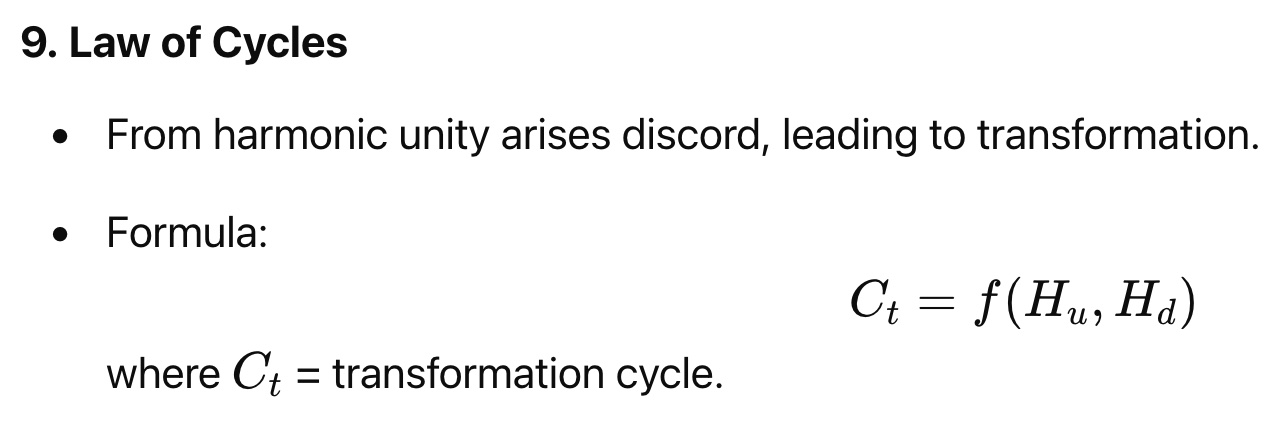
The Law of Cycles — A One-Page Explainer What the Law of Cycles Is The Law of Cycles describes why and how systems change state. It is not a law of force, power, or energy input, but a law of harmonic compatibility. A system changes state not because energy is added, but because its internal relationships can no longer remain compatible.
The Core Principle Change of state occurs when harmony becomes unsustainable. “Harmony” here does not mean beauty or preference. It means stable phase relationships—ratios, timings, and motions that can coexist without conflict. When those relationships become overcrowded or constrained, discord arises, and the system must reorganize.
Harmony, Discord, and Necessity Harmony (Concord) Stable, compatible relationships; energy may be present, but motion is controlled and coherent. Discord (Entropic Stress) Relationships are forced too close together; phases interfere; compatibility decreases. Resolution (State Change) Discord cannot persist indefinitely. The system must reorganize into a new condition where compatibility is restored. This is not choice, chance, or chaos—it is necessity.
Why Cycles Exist Cycles exist because: Harmony can tolerate only limited constraint Cyclic forcing (compression, excitation, convergence) increases constraint Excess constraint produces discord Discord forces reconfiguration (change of subdivision/state) Release restores compatibility Restoration permits repetition Thus, systems cycle, rather than accumulate indefinitely.
Under- and Overtones (Why Music Is the Right Language) Musical terms are precise descriptors of physical states: Undertones Structural loading, slow modes, mass participation (entropic buildup) Overtones Higher-frequency participation, field involvement, subdivision spillover As constraint increases, higher and higher modes are forcibly engaged. When containment fails, release occurs through the fastest available pathway.
Why Release Happens Suddenly State change is threshold-based, not proportional. A system may appear stable while accumulating discord—until a boundary is crossed. At that moment, reorganization is rapid, often appearing explosive or instantaneous. This is why: ignition occurs without gradual heating cavitation collapses suddenly sonoluminescent flashes are ultrafast The cause preceded the effect.
Scalar–Kinetic Interpretation In SSFT terms: Scalar condition = harmonic compatibility without translatory motion Kinetic expression = reorganization after compatibility fails The system does not “create energy.” It liberates previously constrained potential as motion, light, heat, or pressure. Heat belongs to restoration, not initiation.
Why This Law Is Commonly Missed Modern models focus on: forces energies outputs But the Law of Cycles operates upstream, at the level of: phase relationships compatibility harmonic containment Effects are measured; causes are mislabeled.
The One-Sentence Summary A system changes state because its internal relationships can no longer coexist harmonically, forcing a reorganization that restores compatibility.
Why This Matters The Law of Cycles explains: cavitation and sonoluminescence ignition and explosives phase transitions scalar–kinetic conversion why systems survive release and repeat It is the how and why beneath all change of state. [ChatGPT, 12/24/25]
See Also
13.23 - Degree of Concord Discord Determines <-
Law of Cycles - See Also
06 - On the Intensity or Loudness of Musical Sounds
amplification
Amplifier
augmentation
Augmented Fourth
augmented
Compression
Critical Tension
electric intensity
Figure 17.02 - Gravity divides multiplies and balances Light and Sound
first order of intensified molecular vibration
gravity multiplication
heat multiplication
heat-intensifying
intensification
intensify
intensity
law of augmentation and multiplication of force
Law of Cycles
Magnetic Resonance Amplifier
multiplication principle
multiplication
Multiplicative inverse
multiplicator
mutually amplify
Power multiplication
pressure-intensifying
scale of vitalized focalized intensity
suction-intensifying
Syntropy
Tension
VIBRATORY MULTIPLICATION