
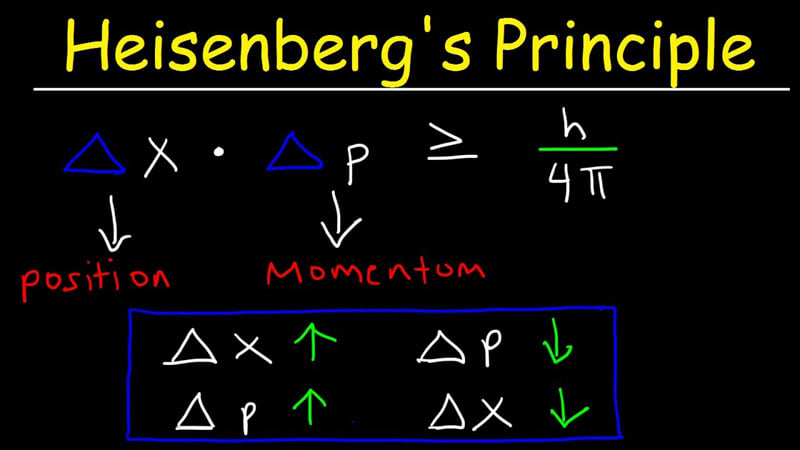
In quantum mechanics, the Heisenberg uncertainty principle states by precise inequalities that certain pairs of physical properties, such as position and momentum, cannot be simultaneously known to arbitrarily high precision. That is, the more precisely one property is measured, the less precisely the other can be measured.
Published by Werner Heisenberg in 1927, the principle means that it is impossible to determine simultaneously both the position and the momentum of an electron or any other particle with any great degree of accuracy or certainty. This is not a statement about researchers' ability to measure the quantities. Rather, it is a statement about the system itself. That is, a system cannot be defined to have simultaneously singular values of these pairs of quantities. The principle states that a minimum exists for the product of the uncertainties in these properties that is equal to or greater than one half of the reduced Planck constant (ħ = h/2π). (wikipedia)
Werner Heisenberg introduced a key idea in quantum mechanics called the uncertainty principle. It says that you cannot know both the exact position and exact momentum of a particle at the same time. This limit is not due to weak tools or poor experiments. It is built into the nature of matter itself.
The principle comes from wave behavior. Particles at tiny scales act like waves. A wave that is tightly focused in space has a wide range of possible momenta. A wave with a clear single momentum spreads out in space. Because matter behaves in this dual way you cannot lock both values at once.
If a scientist tries to measure a particles position with great precision the momentum becomes more uncertain. If the scientist tries to get a very precise momentum the position becomes more spread out. This trade off appears no matter how advanced the measurement device may be.
The uncertainty principle shows that the small world does not follow the same rules as the larger world. Objects like cars or planets have positions and speeds that we can measure clearly. Tiny particles do not work this way. Their values shift with the act of observation.
Heisenberg's idea changed the direction of physics. It helped build the base of quantum theory. It also showed that nature has limits that cannot be broken. The principle guides research in atoms light and particles and remains a central rule in modern science.
Few ideas in science have challenged our understanding of the universe as deeply as the Heisenberg Uncertainty Principle. Introduced by German physicist Werner Heisenberg in 1927, the principle revealed that at the quantum level, there are limits to what can be known about nature with complete precision.
The concept is often misunderstood. It does not mean that scientists lack sufficiently advanced instruments or that measurements are simply imperfect. Instead, it describes a fundamental property of the physical world. According to the principle, the more accurately a particle's position is measured, the less accurately its momentum can be known at the same time. The reverse is also true. Both properties cannot be determined with unlimited precision simultaneously.
This discovery marked a major departure from classical physics, where the universe was often viewed as a giant machine governed by predictable laws. In the classical picture, knowing enough information about an object should allow its future behavior to be calculated exactly. Quantum mechanics revealed a different reality. At extremely small scales, nature behaves in ways that are governed by probabilities rather than certainty.
The Uncertainty Principle became one of the foundations of modern quantum theory. It helped scientists understand why particles do not behave like tiny billiard balls following fixed paths. Instead, quantum particles are described by probability distributions that indicate where they are likely to be found and how they are likely to behave when measured.
This shift in thinking transformed physics and opened the door to some of the most important scientific advances of the last century. Technologies that rely on quantum principles now play a central role in everyday life. Semiconductors, which power computers, smartphones, and countless electronic devices, were developed using knowledge gained from quantum mechanics. Lasers, medical imaging systems, and many modern communication technologies also depend on principles that emerged from the quantum revolution.
Today, researchers are applying these same ideas to build quantum computers, machines that use quantum properties such as superposition and entanglement to process information in entirely new ways. While the technology is still developing, it represents one of the most promising frontiers in science and engineering.
The Heisenberg Uncertainty Principle remains remarkable because it challenges our intuition. In everyday life, we expect objects to have definite positions and predictable motion. The quantum world follows different rules. Rather than being fully deterministic, it is governed by probabilities that place fundamental limits on certainty.
Almost a century after its discovery, the principle continues to influence how scientists study the universe. It serves as a reminder that reality is often more complex, and more fascinating, than human intuition first suggests. By accepting uncertainty at nature's smallest scales, physicists unlocked a deeper understanding of the cosmos and paved the way for technologies that have transformed modern society.
Source: [Heisenberg, W. (1927). On the Perceptual Content of Quantum Theoretical Kinematics and Mechanics; historical and educational resources on quantum mechanics and modern physics]
See Also
approximation
DIRECT OBSERVATION UNRELIABLE
method of exhaustion
Observation
Thought
Werner Heisenberg