
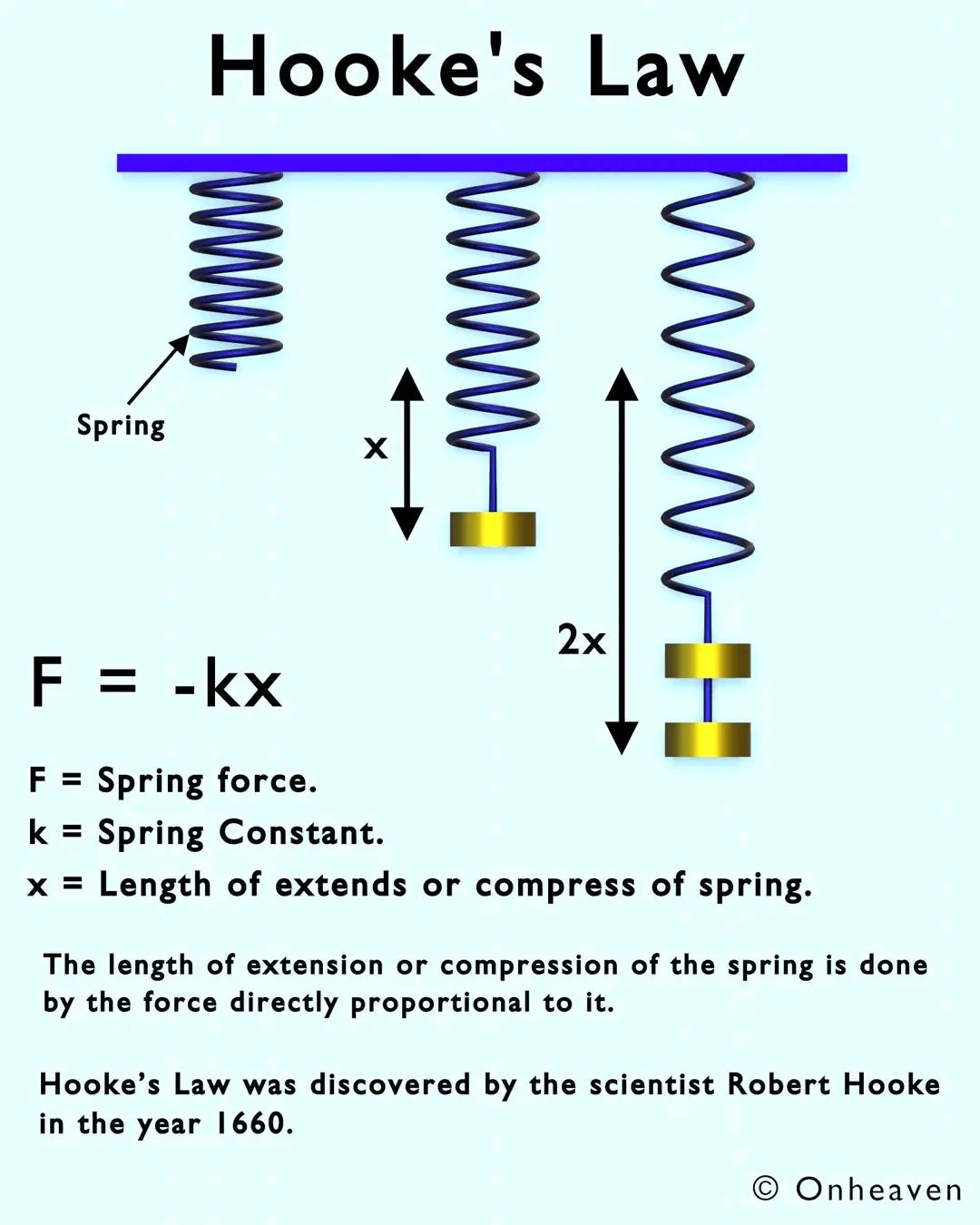
In 1678, Robert Hooke introduced a fundamental principle in physics known as Hooke’s Law. This law describes the relationship between the force applied to a spring and its resulting extension or compression. Essentially, Hooke’s Law states that the amount a spring stretches or compresses is directly proportional to the force applied, provided that the spring is not pushed beyond its elastic limit.
The key concept in Hooke’s Law is the “elastic limit.” This refers to the point at which a spring can no longer return to its original shape after the force is removed. If the force applied to the spring exceeds its elastic limit, the spring may become permanently deformed and no longer function as intended. Hooke’s Law holds true only within the elastic limit, making it a crucial principle for understanding how materials behave under stress.
Mathematically, Hooke’s Law is often written as F = kx, where F is the force applied, k is the spring constant (which depends on the stiffness of the spring), and x is the extension or compression of the spring. This simple equation allows us to predict how a spring will behave when subjected to various forces, which is vital in many engineering and scientific applications.
Hooke’s Law is not limited to just springs. The principle has been extended to other materials and structures that can undergo deformation, such as rubber bands or metal rods. Understanding how materials stretch or compress in response to applied forces is important in fields like material science, civil engineering, and even biomechanics, where similar principles govern how biological tissues respond to stress.
In the end, Hooke’s Law remains one of the cornerstones of mechanics, helping us understand the behavior of elastic materials and providing a foundation for much of modern engineering. Its simplicity and practicality have made it a key tool in both theoretical physics and everyday applications, from the design of shock absorbers to the construction of bridges and buildings. Hooke’s insights continue to shape our understanding of how materials respond to forces, influencing a wide range of technologies and innovations.
See Also