
On February 18, 1943, construction began on the first building (9201-1) at the Y-12 Electromagnetic Separation Plant in Oak Ridge, TN. Y-12’s primary wartime purpose was to separate uranium 235 from uranium 238 for use in the world’s first atomic weapons. At the plant’s peak of operations in 1945, more than 22,000 workers including the famous Calutron Girls undertook this top-secret mission. On August 6, 1945, the US military dropped the Little Boy atomic bomb on Hiroshima, Japan, fueled by enriched uranium separated at Y-12.
Y-12’s nuclear research and development continued through the Cold War through the present day, where the complex remains a highly-secured facility operated for the US Department of Energy. https://www.nps.gov/mapr/index.htm
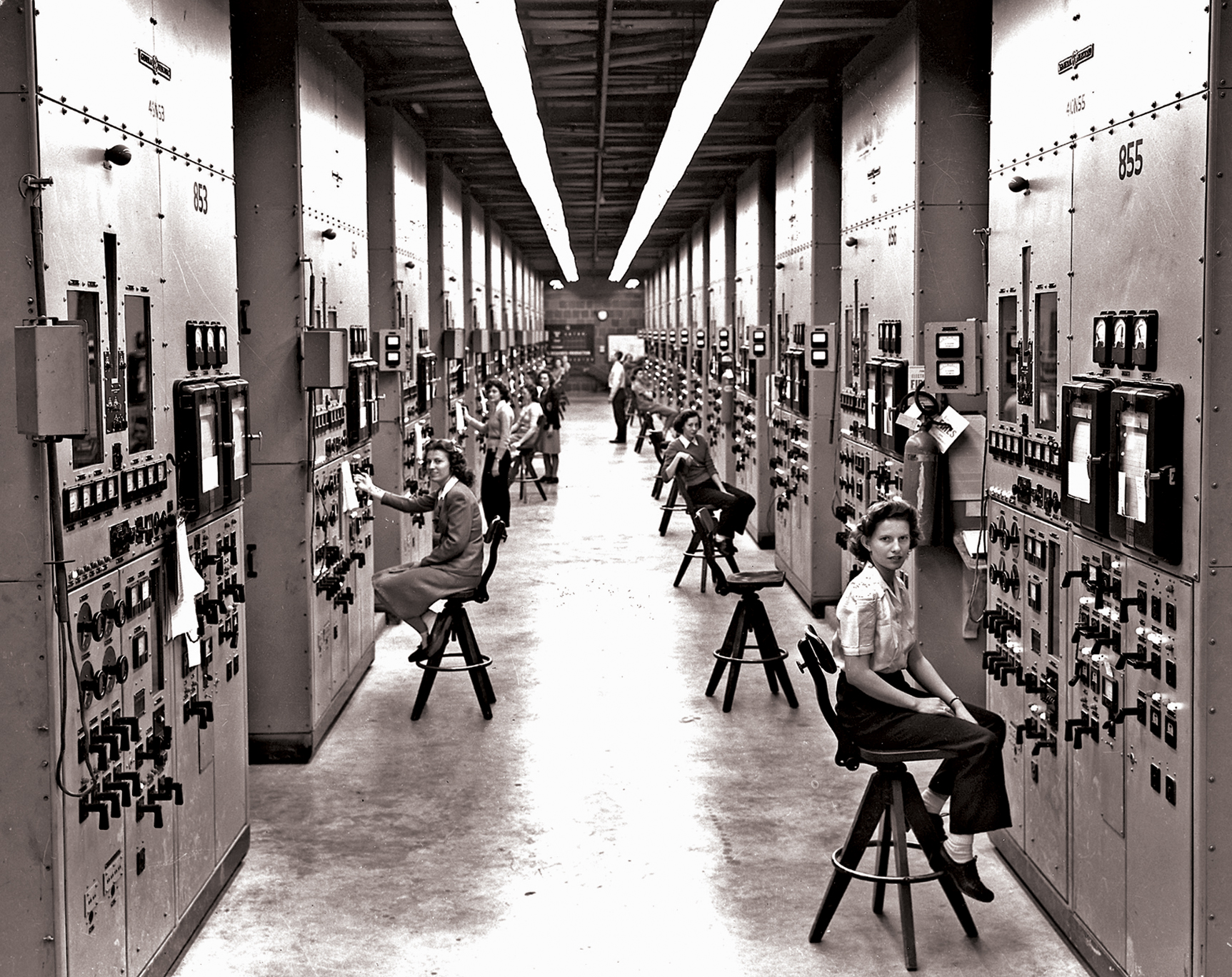
Calutron Girls
The story of the Calutron Girls is a remarkable chapter in the history of the Manhattan Project, offering a glimpse into the pivotal role played by young women in one of the most secretive and groundbreaking scientific endeavors of World War II.
Recruited mostly from high schools, these young women embarked on a journey that would take them to the heart of the war effort, to the Y-12 National Security Complex located at Oak Ridge, Tennessee. Tasked with operating calutrons, a type of mass spectrometer used to separate isotopes of uranium for the production of enriched uranium, these women became an indispensable part of the project.
Their work was shrouded in secrecy, with many of them unaware of the true nature of their tasks or the significance of the project they were contributing to. Working long hours in challenging conditions, they displayed remarkable dedication and resilience, often under the pressure of strict security protocols and the weight of the knowledge that their work could potentially alter the course of the war.
Despite the demanding nature of their roles, the Calutron Girls approached their duties with a sense of duty and patriotism, driven by a collective desire to support the war effort and bring an end to the conflict. Their contributions were instrumental in the success of the Manhattan Project, playing a crucial role in the development of the atomic bomb and ultimately helping to bring about the end of World War II.
After the war, many of these women returned to their civilian lives, their contributions largely overlooked and overshadowed by the secrecy surrounding the project. However, their legacy endures as a testament to the often unsung heroines of wartime science and the vital role played by women in advancing scientific discovery and innovation.
The Paper-Moth Keepers of the Manhattan Project
In the secret city of Oak Ridge, Tennessee, during WWII, thousands of young women—many fresh from rural Appalachia—operated the calutrons that enriched uranium for the atomic bomb, unaware of what they were building. Among them, Librarian Iris Pelley noticed the strange, constant static electricity in the air was causing the library's paper to become brittle. To protect the books, she began treating them with a secret mixture of beeswax and a local plant resin. She discovered this mixture also made paper temporarily resistant to the facility's powerful magnetic fields. She and a circle of other "library girls" began using treated paper to create tiny, folded "message moths." These could be slipped into vents or left in bathrooms, carrying whispers of suspicion, questions about the work's purpose, and words of comfort, evading the ever-watchful military censors. They traded these fragile messages for small comforts—lipstick, nylons—building a fragile web of shared doubt and humanity within the heart of the bomb project. Iris said: "They are building a terrible light. We are preserving the right to whisper in the dark." Theirs was a quiet resistance of questions, a testament to conscience in the midst of history's most secretive endeavor.
Beginning construction in Oak Ridge in June 1943, the K-25 Gaseous Diffusion Plant, with its distinctive U shape, was the largest building in the world during the Manhattan Project. Covering a 44-acre tract over one-half mile long and 1,000 feet wide, this top-secret facility employed over 10,000 workers at its height of operation in 1945.
The K-25 Gaseous Diffusion Plant, along with two other nearby massive Manhattan Project facilities, the Y-12 Electromagnetic Isotope Separation Plant and the S-50 Liquid Thermal Diffusion Plant, operated with the intent of enriching or separating lighter uranium-235 from heavier uranium-238.
Unlike the processes used at Y-12 and S-50, K-25 relied on over 3,000 gaseous diffusion steps through which uranium hexafluoride gas could pass through. This process allowed for smaller uranium-235 atoms to pass through the tiny pores in the barriers of each step, enriching the gas and creating a higher concentration of uranium-235. This gaseous diffusion method proved cheaper and more efficient than Y-12's electromagnetic separation process and S-50's liquid thermal diffusion process. Uranium-235 enriched at S-50, K-25, and Y-12 was used in Little Boy, the atomic bomb dropped on Hiroshima, Japan on August 6th, 1945.
The K-25 complex produced enriched uranium for defense and commercial purposes until the mid 1980s. Its benchmark gaseous diffusion method was the only uranium enrichment method used by the United States during the Cold War. In 2013, due to its deteriorated condition, Department of Energy contractors demolished K-25.
See Also